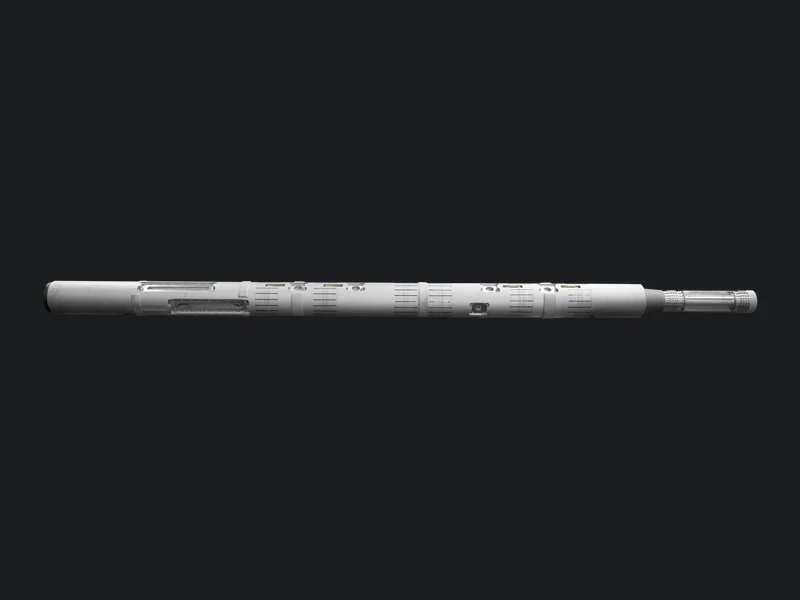
A pressure vessel, a sensor chassis and a drill-string component in one slender tube — and three of its requirements fight each other.
Thin-wall pressure housings for downhole MWD/LWD tools. BTA deep-hole envelope 12,000 mm, wall-deformation control on slender non-magnetic blanks, parts validated for 180 °C / 180 MPa service. An engineer answers the drawing, not a salesperson.
| Capability | Detail |
|---|---|
| Materials | P550-class non-magnetic stainless, Inconel 718, titanium alloys, high-strength steels — permeability verified on incoming non-magnetic stock |
| Deep-hole envelope | BTA line to 12,000 mm travel, with Ø20–300 × 10,000 mm proven in production; gun drilling from Ø2 mm to 6,000 mm depth |
| Straightness | 0.5 mm/m on the BTA line over full length |
| Large-part machining | Self-built FWG-M1260 five-face gantry, travels 6,000 × 1,200 × 650 mm, four-axis simultaneous plus angle head |
| 5-axis cavities | Mazak VARIAXIS i-800 (Ø800 class) and C-600 (Ø630 class); sensor pockets, antenna recesses and inclined cross-holes in one setup |
| Inspection | CMM travels to 1,200 × 4,000 × 1,000 mm; full-length ultrasonic testing; dimensional report with every part |
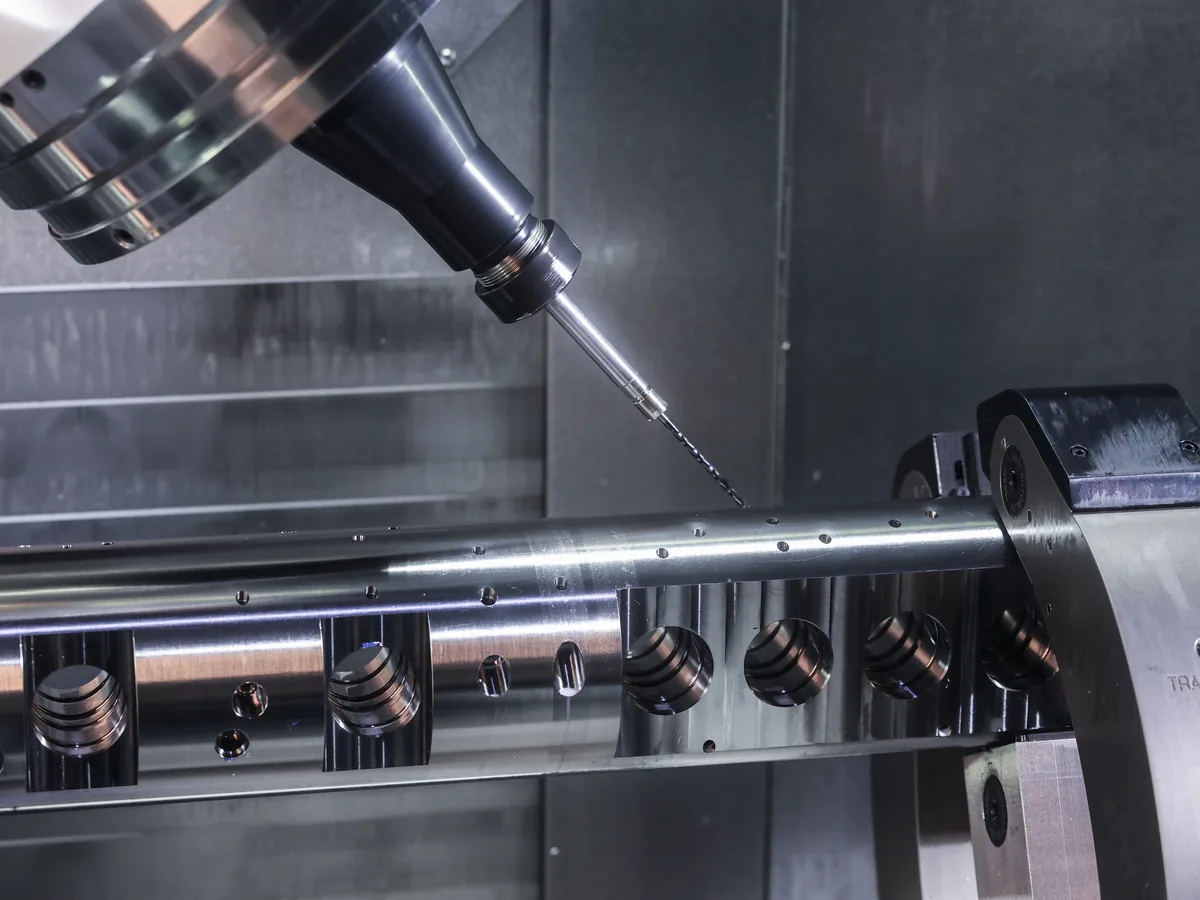
Wall sections are machined thin to open up the electronics bay, over lengths that make the blank behave like a beam rather than a part. Release the clamps and it springs; release residual stress mid-cut and it bows. The ceiling here is wall deformation, not spindle power.
MWD tools measure the earth’s magnetic field, so the housing must not distort it. P550-class stainless holds that permeability requirement — and work-hardens aggressively under the tool, punishing a hesitant feed or a dulled edge.
The electronics bay, pressure bulkheads and seal bores sit metres inside the part. They have to stay round, concentric and correctly finished where no operator can see or reach them — and at 180 °C / 180 MPa a seal bore is a pressure boundary, not an ordinary feature.
LWD housings carry sensor pockets, antenna recesses and inclined cross-holes. Only simultaneous 5-axis interpolation gets to them in one setup; each re-clamp is a fresh chance for positional error.


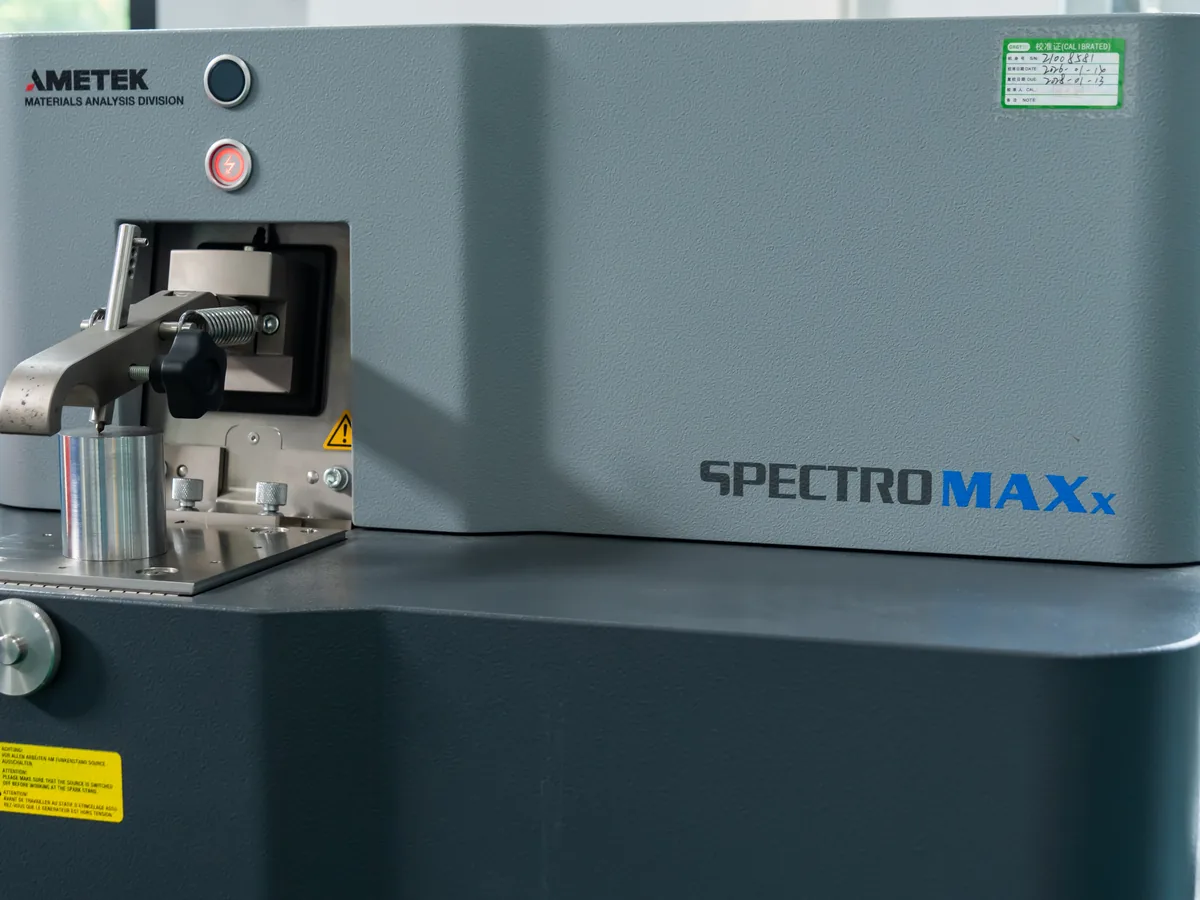
Chemistry, microstructure and mechanical properties in our own materials lab before the first cut; permeability verified on non-magnetic stock
BTA or gun drilling establishes the through-bore; deep-hole boring and internal-groove machining follow in the same clamping
Sensor pockets, antenna features and inclined cross-holes on simultaneous 5-axis centres; large slender housings on the self-built FWG-M1260 gantry
Vacuum hardening and stress-relief annealing sequenced against the machining plan, so distortion lands where allowance remains
Seal bores and OD sealing surfaces finished in-house; deep-hole honing corrects size and roundness over full length
CMM, full-length ultrasonic testing, and a dimensional report that ships with the part
The DFM feedback we give on housings: wall-thickness sequencing against bore depth, seal-groove geometry that survives pressure cycling, datum schemes that keep the electronics bay concentric to both threaded ends, and when a split structure welded or shrink-fitted beats a monoblock blank. These arrive before an invoice does.
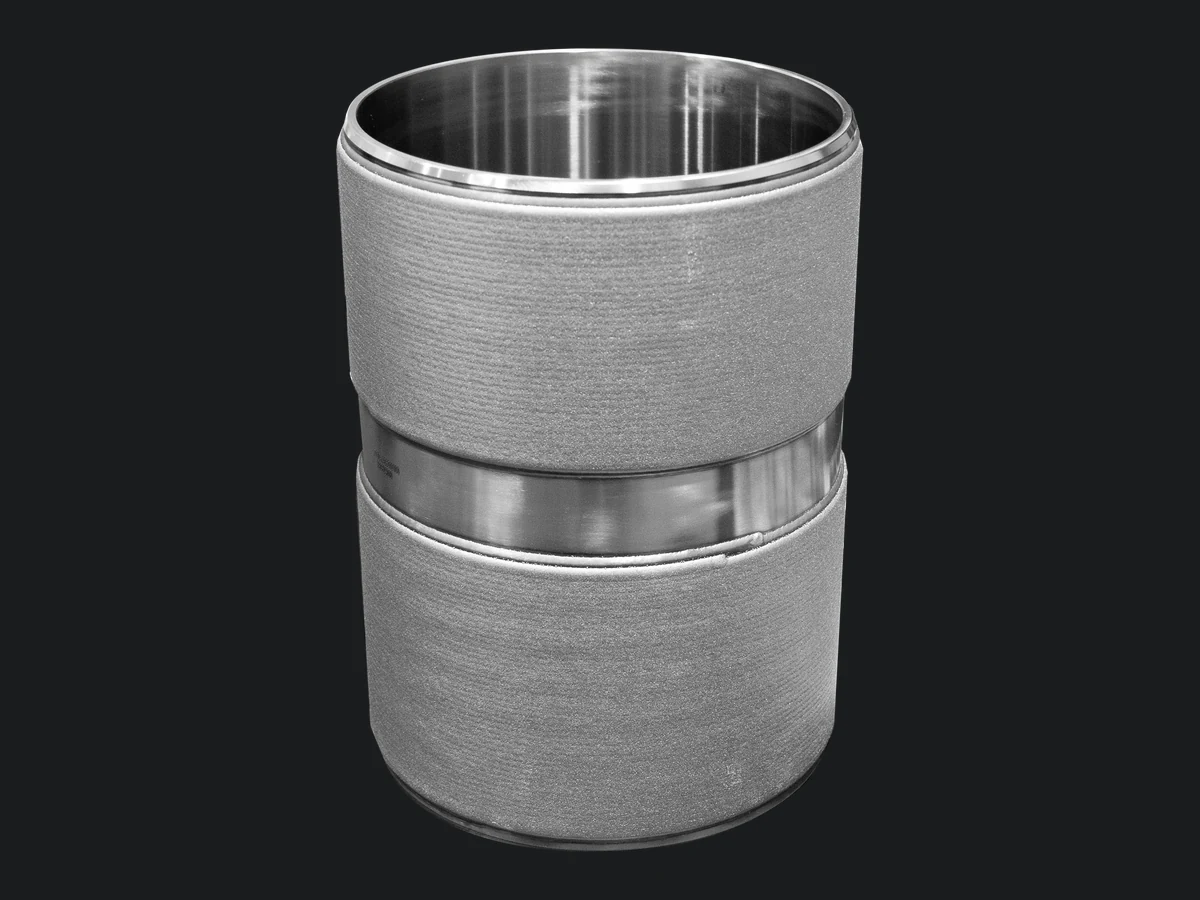
Surface and special processes run in-house: hard chrome and electroless nickel with the coating allowance engineered into the machining program, shot peening for fatigue life, laser cladding of tungsten-carbide nickel-base wear bands, vacuum potting support for downhole electronics, and NACE MR0175 handling where sour service is specified. No subcontracting — one roof, one quality system, one lead time someone owns.

TÜV Rheinland certified, certificate No. 01 100 019813, continuously certified since 2002
API Spec Q1 (Q1-4969, 10th Ed.) and API 7-1 / 7-2 are held by our joint venture Zhonghai Wantai, not by Zhongnan Machinery. Housing programmes are machined and validated on JV lines under that system. We state the facts because the certificates are not ours.
The rotary-steerable systems we supply components for have completed over 3,700 wells and 3.6 million metres drilled
180 °C / 180 MPa high-temperature, high-pressure vessel; 25 MPa water-loop stand for instrument strings up to 50 m; 60-ton dual-shaker vibration table
Heat-number traceability, frozen routings after part approval, dimensional inspection reports with every order; FAI packages and third-party inspection on request
Yes — that is the core of this part family. We combine same-setup BTA drilling and boring, stress-relief heat treatment sequenced between operations, and deep-hole machines adapted specifically to support slender thin-wall blanks over full length. Straightness on the BTA line is 0.5 mm/m.
Yes. P550-class non-magnetic stainless is in batch production with us for MWD applications. These alloys work-harden aggressively, so our parameter windows and tooling strategy come from years of downhole part experience. Permeability is verified at incoming inspection, before any material reaches a machine.
Our BTA envelope is 12,000 mm of machine travel, with Ø20–300 × 10,000 mm proven in production. Gun drilling starts at Ø2 mm and reaches 6,000 mm depth. If your part sits between those two lines, send the drawing and we will tell you which one it belongs on.
Yes — electronics and circuit skeletons are related parts in production. Small precision features inside pressure housings are routine for our 5-axis and turning cells, and matched housing-plus-skeleton orders are welcome, because the fit between them is the point.
That validation runs on JV infrastructure: a high-temperature/high-pressure vessel rated 180 °C / 180 MPa, a 25 MPa water loop for complete instrument strings up to 50 m, and a 60-ton dual-shaker vibration table. The tool is proven before it goes downhole.
The drawing, the material grade, bore depth and diameter, wall thickness at the thinnest section, the permeability limit, quantity and target delivery. An engineer — not a salesperson — replies within 24 hours with manufacturability feedback; the quote follows once the information is complete.
Bore depth, wall thickness at the thinnest section, the permeability limit and the service envelope — those four decide whether the part is routine or difficult. Send them with the drawing and we will tell you which.
STEP / DWG / DXF / PDF welcome. NDA first if you prefer — yours or ours.
Related: Oil & Gas Drilling|P550 Non-Magnetic Machining|Deep-Hole Drilling|Rotary Steerable Components