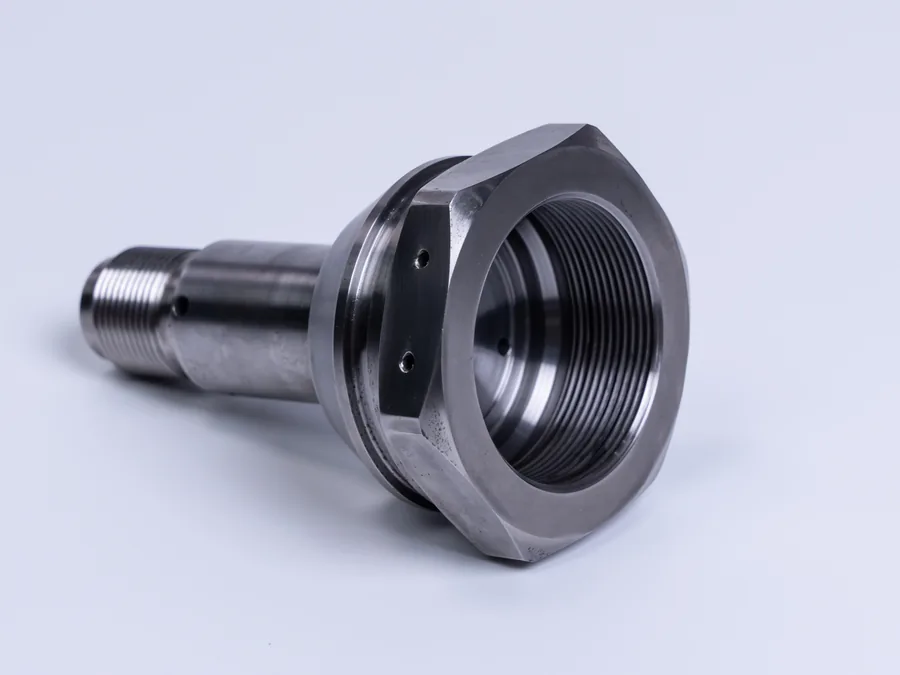
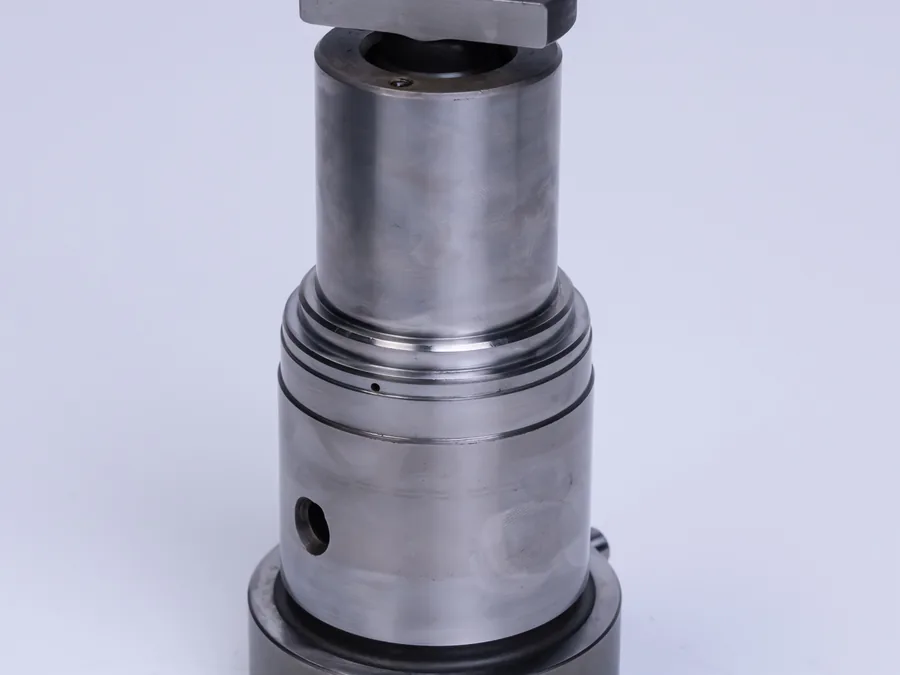
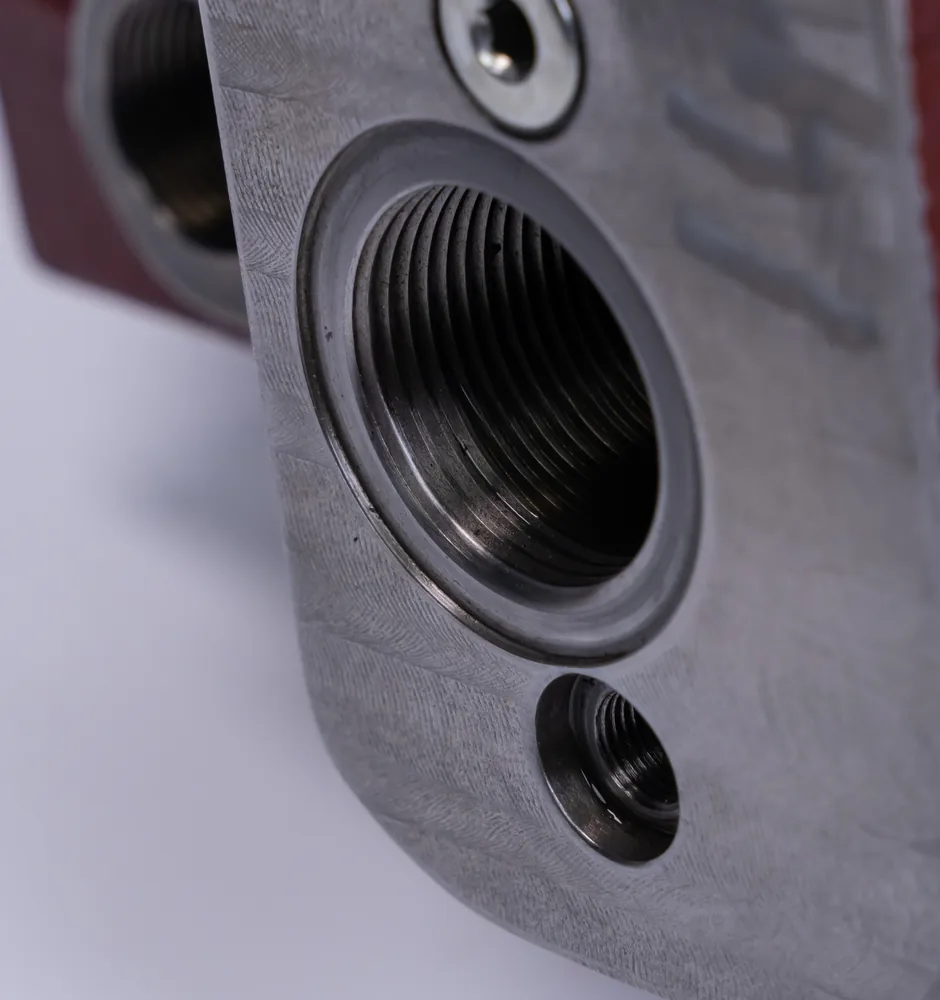
Titanium parts held to 0.005 mm and Ra 0.4 μm — 5-axis on Mazak VARIAXIS centers, five-face gantry to 6 m. Running today in commercial aviation and deep-sea robotics programs. Upload your drawing via the RFQ form — an engineer replies within 24 hours.

Titanium’s reputation is built on three properties that gang up on the cutting edge.
Built-up edge (BUE). Titanium is chemically friendly — too friendly. At the wrong speed, the material pressure-welds itself to the cutting edge, micro-weld by micro-weld, until the built-up mass breaks away and takes a piece of the tool with it. Speed selection in titanium is not optimization; it is survival.
Heat that goes nowhere. Titanium’s thermal conductivity is a fraction of steel’s. Cutting heat does not leave with the chip — it concentrates at the tool edge, accelerating wear and inviting the welding described above. Coolant delivery is not a comfort feature here; it is process control.
It bends away from the cut. Low elastic modulus means the workpiece deflects under cutting pressure — thin walls spring, slender shafts walk, and the dimension measured with the load on is not the dimension with the load off. Chatter follows deflection. Fixturing, support, and pass sequencing matter as much as the insert grade.
These behaviors are learned in scrapped parts, over years. We have already paid that tuition.
| Process | Envelope / range | Notes |
|---|---|---|
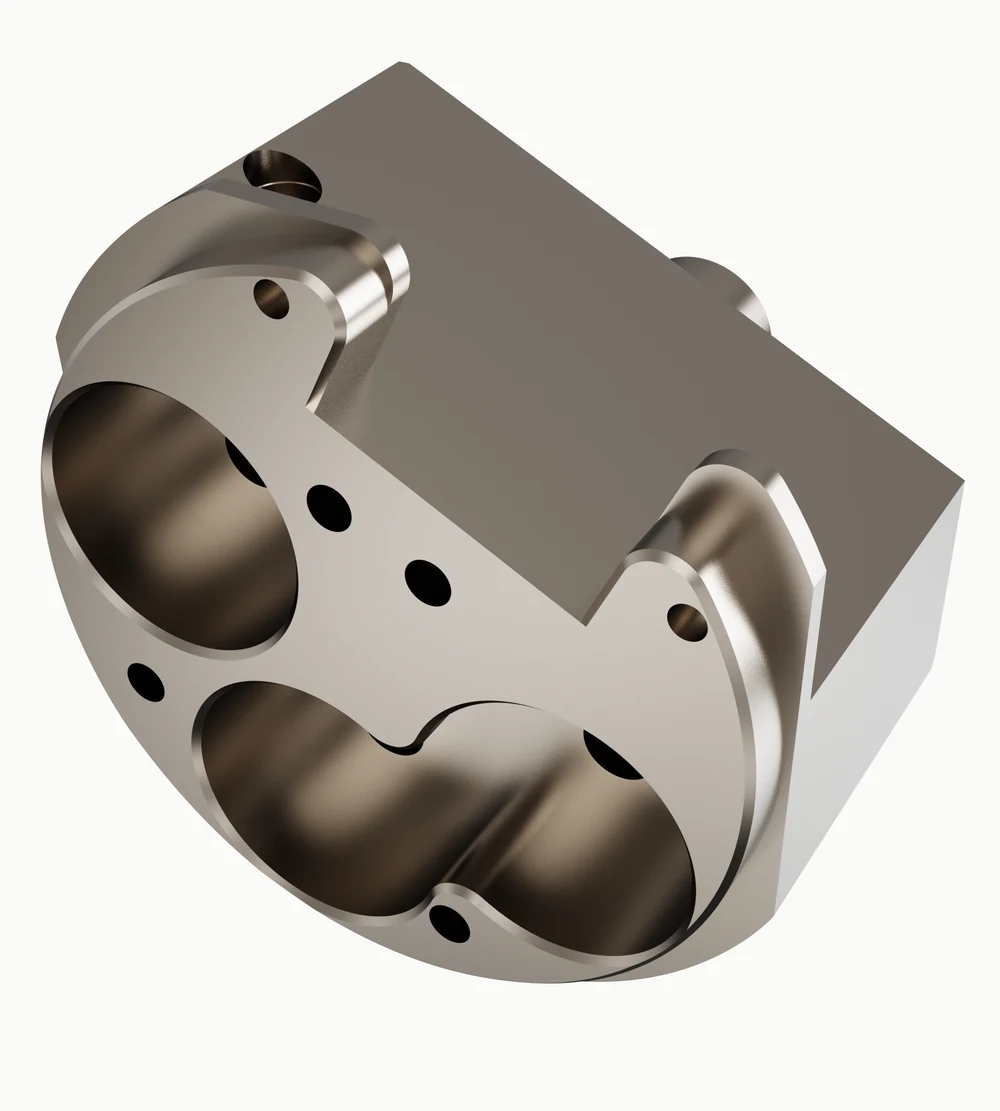
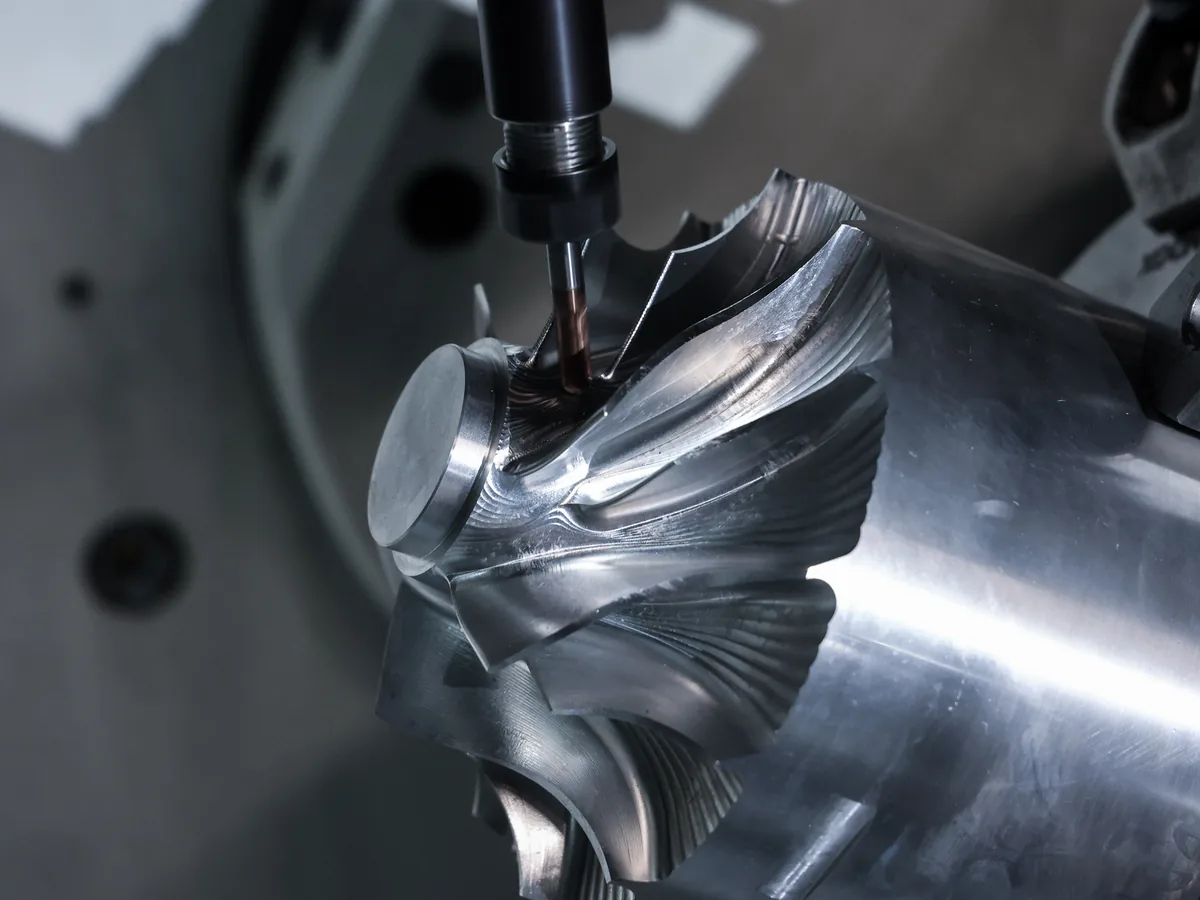
| 5-axis CNC machining | Mazak VARIAXIS i-800 (Ø800 class) & C-600 (Ø630 class); meter-to-12 m parts on self-built FWG-M1260 five-face gantry (travels 6/8/12 m) | True simultaneous 5-axis; in-house CAM; meter-scale fixturing and full-travel thermal management |
| CNC turning & mill-turn | To Ø800 × 8,000 mm (FWT-80800); shop envelope Ø1,000 × 10,000 mm | ±0.01 mm at the machine; slender shafts to 4,500 mm — steady rests and stress-managed sequencing |
| Gun drilling / deep-hole | Ø2–40 mm, depths to 6,000 mm; hole tolerance ±0.02 mm | 13 machines designed and built in-house |
| Precision grinding | Cylindrical to φ500 × 3,000 mm (MQ1350B), φ125 × 500 mm (MGB1412); internal φ200 × 250 mm (×2, Swedish) | Titanium ground as routine; to 0.005 mm, Ra 0.4 μm |
| Metal 3D printing | DiMetal-400 SLM, build envelope 400 × 400 × 400 mm; titanium alloys supported | Honest scope: research, prototype and single-piece work; 5-axis finishing and grinding under the same roof |
| Heat treatment & surface | Vacuum heat treatment, hard anodize-adjacent coatings (hard chrome / electroless nickel / PTFE where specified) | Coating allowance engineered into the machining program |
Commercial aviation. TC4, TC11 and TC18 run in structural parts for a national civil aircraft program — semi-finish and precision machining on Mazak VARIAXIS 5-axis centers and our self-built FWG-M1260 five-face gantry, with final operations completed by a certified member of our group. We support commercial aviation programs only. See Aerospace →
Deep-sea robotics. Complete deep-sea manipulator arms are in production today — joint housings, structural links, pressure-compensation seal parts — machined in titanium and specialty alloys, finished to pressure-rated sealing surfaces. A robot that fails kilometers underwater gets written off, not serviced; titanium’s strength-to-weight ratio is why the design calls it, and our process discipline is why the seals still seal at depth. See Deep-sea manipulator components → and Robotics industry page →


Speeds and feeds are earned per part and frozen into the routing. The doctrine we can share:
The cutting zone is kept where titanium shears instead of welds, with sharp edges replaced before they become welding surfaces
High-pressure delivery aimed at the shear zone, because in titanium the heat stays with the tool
Thin walls roughed and finished in an order that keeps the section stiff; slender shafts run against steady rests with stress-managed sequencing
Where turning and milling leave the last microns arguing with spring-back, in-house grinding settles the argument to 0.005 mm and Ra 0.4 μm
Once a titanium part is proven, routing, parameters and inspection plan are locked; reorder No. 50 is made exactly the way reorder No. 1 was approved
Difficult alloys demand proof at both ends — what the mill delivered, and what we shipped:
The mill origin of every titanium billet follows your part through every operation to the inspection report
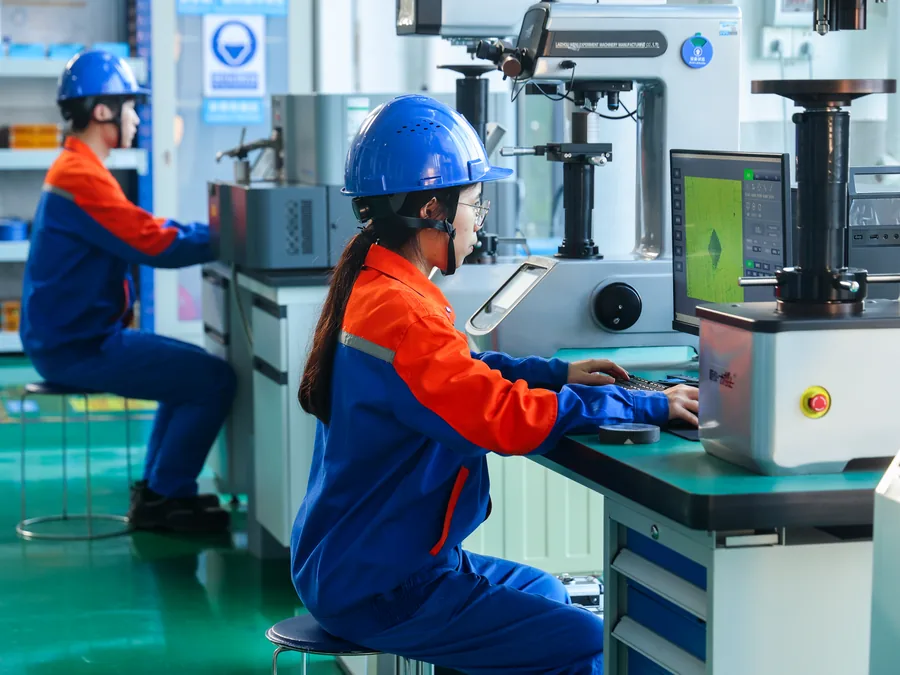
Optical emission spectrometry on every incoming lot (50+ elements); no certificate taken at face value
Tensile and impact testing in our own lab; metallography and SEM available for microstructure questions
Mill certs plus dimensional inspection reports; FAI packages prepared to your format on request

TC4 (Ti-6Al-4V), TC11 and TC18 are in current production. Other grades enter through the same honest review: send the drawing and the grade, and we will tell you honestly what we have cut before and what would be new territory.
By staying out of the speed window where titanium pressure-welds to the edge, replacing tools on schedule rather than on failure, and delivering coolant into the shear zone. BUE is a process discipline problem, not a luck problem.
5-axis work on Mazak VARIAXIS centers and five-face gantry parts to 12 m, turning to Ø800 × 8,000 mm, deep holes to 6,000 mm by gun drilling, and grinding to 0.005 mm / Ra 0.4 μm. From 1 piece — no minimum order — through batch production.
Yes — printing and precision finishing sit under one roof: SLM printing in titanium alloys, then 5-axis finish machining, grinding, and heat treatment on the same drawing. Our honest scope for additive is research, prototype and single-piece work.
Every order ships with material certificates carrying heat-number traceability plus dimensional inspection reports; FAI packages and third-party inspection on request.
Attach the drawing and the grade; an engineer replies within 24 hours with manufacturability feedback.